
During April-September, the eight sectors grew by 4 per cent, against 5 per cent in the year-ago period.

The growth is particularly remarkable because it comes at levels higher than during the pre-Covid times, notes Mahesh Vyas.

Stock markets would take cues from the upcoming macroeconomic data announcements and global trends besides keeping a watch on the trading activity of foreign investors, analysts said. The last batch of the ongoing earnings calendar would trigger stock-specific action, traders said. "This week, we have to deal with macroeconomic data on both the domestic and global front.

Wholesale inflation fell to a 3-month low of 2.04 per cent in July on decline in prices of food items especially vegetables, government data released on Wednesday showed. The decline in wholesale price index (WPI) based inflation in July came after it rose for four months in a row till June, when it was 3.36 per cent. It was (-) 1.23 per cent in July last year. In April wholesale inflation stood at 1.19 per cent.

As per data released by the government on Monday, industrial output grew by 3.5 per cent in the April-October period this fiscal, as against 8.7 per cent in the same period last year.

In comparison, industry grew by 2.1 per cent in May last year.
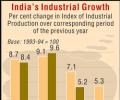
The Indian industry logged 8.5 per cent growth in October 2005, compared to 10.6 per cent in the same month last fiscal.

India's annual industrial output growth slowed to 4.2 per cent in July compared with an upwardly revised 4.4 per cent growth a month ago, government data showed on Friday.
NTPC, Hero MotoCorp and Reliance Industries down 2% each among the top losers

The growth of eight key infrastructure sectors slowed down to a 4-month low of 8.1 per cent in September 2023 against 8.3 per cent a year ago, according to the official data released on Tuesday. The growth rate in the output of refinery products, fertiliser, cement and electricity during the month under review has decelerated, while it was negative in the case of crude oil. The previous low was in May, when the growth rate of these sectors stood at 5.2 per cent.

India's industrial output unexpectedly rose 1.2 per cent in May from a year earlier, led by a pick up in manufacturing, government data showed on Tuesday.

Slowdown in industrial production notwithstanding, a marginal increase in inflation raised the clamour for another round of rate cut by the Reserve Bank on April 4 to boost economic activity.

The stock market is likely to continue with its positive momentum but may face bouts of profit-booking amid lofty valuations in this holiday-shortened week, analysts said. The trading sentiment will be guided mostly by global trends in absence of major domestic events, they said. Markets would remain closed on Friday for 'Ganesh Chaturthi'.
The fiscal 2008-09 began on somber note with industrial growth in April dropping to 7 per cent compared to 11.3 per cent in the same month a year ago, reflecting the impact of higher interest rates and rising input costs.The performance in April, however, was much better than the 3.9 per cent growth rate witnessed during March, the last month of the previous fiscal, according the Index of Industrial Production (IIP) data released on Thursday.
Decline in production of crude oil coupled with a slowdown in output of other products pulled back the growth of six key infrastructure industries to 5.3 per cent in June compared to 7.7 per cent a year ago.

The previous low was recorded at 3.8 per cent in May this year.

In what could somewhat blunt the criticism over reliability of data, particularly Index of Industrial Production, the Union government has come out with rules prescribing Rs 1,000 fine for individual and Rs 5,000 for company if they neglect furnishing information to government agencies for statistical purposes or refuse to do so.

The growth of eight key infrastructure sectors slowed down to 4.3 per cent in May 2023 due to a decline in the production of crude oil, natural gas and electricity, according to the data released by the government on Friday. The core sector growth was 19.3 per cent in May 2022, while in April 2023, the key infra sectors recorded a growth rate of 4.3 per cent. During April-May this fiscal, the output growth of these eight sectors slowed down to 4.3 per cent against 14.3 per cent in the year-ago period, the data showed.
The country's industrial growth shot up to 14.4 per cent in November 2006, the fastest in more than a decade, on the back of impressive performance of manufacturing sector and a rebound in mining production.

Wholesale inflation in the country rose for the fourth consecutive month in June at 3.36 per cent on account of rise in prices of food articles, especially vegetables and manufactured items. The wholesale price index (WPI) based inflation was 2.61 per cent in May. It was (-) 4.18 per cent in June 2023.

Industrial growth during the April-June quarter stood at 6.8 per cent.

Economists surveyed by Reuters had forecast a 0.5 per cent growth in output

Industrial production grows at 2.1 per cent in March.
Industrial output fell 3.2 per cent in November.
Correcting the industrial output figures twice within span of a few hours, the government on Thursday said IIP grew at 2.3 per cent in April instead of 2 per cent reported on Wednesday.
India's industrial output grew a better-than-expected 6.4 per cent in August compared with a downwardly revised 4.1 per cent growth a month ago.

Videocon Industries surged 6.3%, Blue Star rose 6% and Titan Industries rallied 3.5% by close of trade on Friday.
Industrial growth in the country revived moderately to 8.8 per cent in June this year on the back of a smart recovery in the manufacturing sector and better offtake of capital goods.

The manufacturing sector, which accounts for over 75 per cent of the total weight of the index, grew by just 5.6 per cent in May.

Despite high headline numbers, the output of one-third of the segments in the manufacturing sector in August stood below even that in the same month in 2011-12, when the new index of industrial production (IIP) series started. This is despite the fact that manufacturing grew 9.3 per cent in the month, driving up IIP growth to a 14-month high of 10.3 per cent. Part of it is due to the devastation of these product categories by lockdowns induced by Covid waves and subdued export conditions, while part of it needs to be assessed further.
The 30-share barometer dropped by 402.22, or 2.37 per cent to 16,464.75 at 1200 hrs with all sectoral indices trading in the negative zone.

Mahindra & Mahindra was the top laggard in the Sensex pack, sliding 2.05 per cent, followed by Bajaj Finance, Tata Steel, SBI, Asian Paints, Kotak Mahindra Bank and Titan. However, IT majors HCL Technologies and TCS defied the trend and gained 1.02 per cent and 0.47 per cent, respectively. FMCG firm Hindustan Unilever rose 0.32 per cent.

Trading in stock markets this week will be majorly influenced by the upcoming quarterly earnings from IT majors TCS and Infosys, along with global trends, analysts said. Besides, global oil benchmark Brent crude, rupee-dollar trend and trading activity of foreign investors would also dictate the movement, they said. "On the domestic front, all eyes will be on the beginning of corporate performance for the third quarter of the current fiscal year.

The wholesale inflation rose for the third consecutive month in May at 2.61 per cent on account of rise in prices of food articles, especially vegetables, and manufactured items. The wholesale price index (WPI) based inflation was 1.26 per cent in the previous month. It was (-) 3.61 per cent in May 2023. "Positive rate of inflation in May, 2024 is primarily due to increase in prices of food articles, manufacture of food products, crude petroleum & natural gas, mineral oils, other manufacturing etc," the ministry of commerce & industry said in a statement on Friday.

Snapping an eight-month trend of double-digit rise, industrial growth slid to 7.1 per cent in June from 8.3 per cent a month ago.

Industrial production in May slowed to 2.7 per cent from 5.6 per cent a year ago, dragged down by manufacturing, strengthening the case for an RBI rate cut.

Benchmark indices continued their downtrend for the fifth session on the trot on Thursday, with the Sensex tumbling nearly 817 points in early trade, tracking weak global trends and selling in index majors Reliance Industries and HDFC Bank. Unabated selling by foreign institutional investors also weighed on the sentiment. The 30-share BSE Sensex was trading 816.78 points lower at 53,271.61. The NSE Nifty declined 234.05 points to 15,933.05.

'Though one cannot paint the entire microcap basket with the same brush, investors need to be careful now as to what they're buying.'
Indian industry has logged a growth of 9.5 per cent in April 2006 as against 8.1 per cent in the same month last fiscal.

From the 30 Sensex firms, IndusInd Bank, Asian Paints, Hindustan Unilever, Tata Motors, Tata Steel, Titan, Reliance Industries and NTPC were among the major laggards. Tech Mahindra, Mahindra & Mahindra, Kotak Mahindra Bank, Infosys, HCL Technologies and State Bank of India were among the major gainers.
 © 2026 Rediff.com - Advertise with us - Disclaimer - Privacy Policy - Sitemap - Feedback - About us - Terms of use - Grievances